Independent technical assessment
Review the inherited code, proposed architecture, sensor and GPU choices, latency bottlenecks, integration risk, IP dependencies and realistic engineering staffing.
IHMP.AI / IGSC.AI is developing a real-time movement-coaching platform: a smart mirror for training on your own, and later for remote sessions with a professional. We're testing technical feasibility and business evidence at the same time.
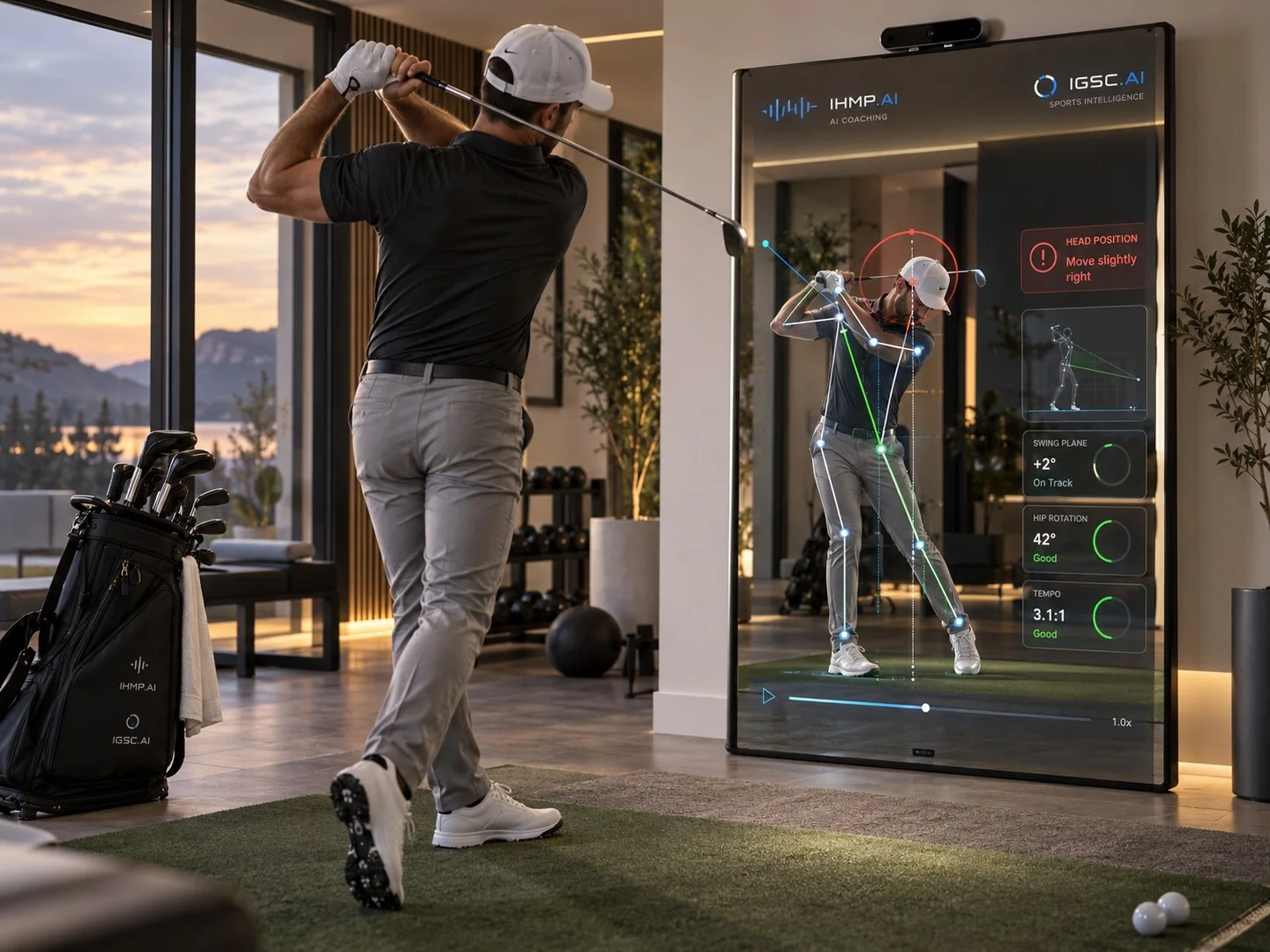 Concept rendering · future state
The images are AI-generated concepts of the planned experience, not photos of a working system. The ≥30 FPS and ≤100 ms figures are engineering goals that haven't been verified yet.
Independent runtime and smart-mirror feasibility assessment.
Proposed Scheller customer discovery and commercialization research.
Golf TAM / SAM / SOM, plus a careful screen of adjacent markets.
Experience the concept · Live in your browser
This is the core idea: a camera sees your body, AI finds your joints, and feedback appears instantly. Watch the demo swing, or turn on your camera and see open-source pose tracking follow you in real time. It also measures how fast your own device runs it.
Camera mode runs Google's open-source MediaPipe pose model on your device. Video never leaves your browser, and nothing is recorded or uploaded. This demo shows the concept. It isn't the IHMP.AI system, and your device's numbers aren't IHMP.AI benchmarks.
Why this stage matters
Existing university-sponsored movement-analysis work is a research starting point. A commercial product needs a reliable chain from camera to pose estimation, motion interpretation, coaching logic and on-mirror feedback, with measured latency and reliability. The next dollars should reduce those risks.
Review the inherited code, proposed architecture, sensor and GPU choices, latency bottlenecks, integration risk, IP dependencies and realistic engineering staffing.
Define a live capture-to-coaching pipeline with measurable acceptance tests. The targets are ≥30 frames per second and ≤100 ms end-to-end latency, both still to be validated.
Tie the measured engineering capabilities to a golf-first workflow, a professional-instruction mode, customer discovery, market sizing and clear criteria for expanding.
Interactive · The 100 ms problem
Live coaching only feels live if the whole chain, from photons to feedback, fits in about a tenth of a second. Drag each stage to see how the end-to-end budget behaves. Measuring this for real is exactly what the technical assessment is for.
Interactive planning model. The starting values are an illustrative split you can adjust, not measured results. The assessment will benchmark each stage on the real hardware, including the ZED 2i depth camera and GPU/edge compute.
One platform · two coaching modes
The vision goes beyond replaying a swing. People could train with on-mirror guidance at home, at school, in a studio or at a practice facility. The same architecture could later support remote sessions with a qualified instructor, coach or therapist, depending on each application's requirements.
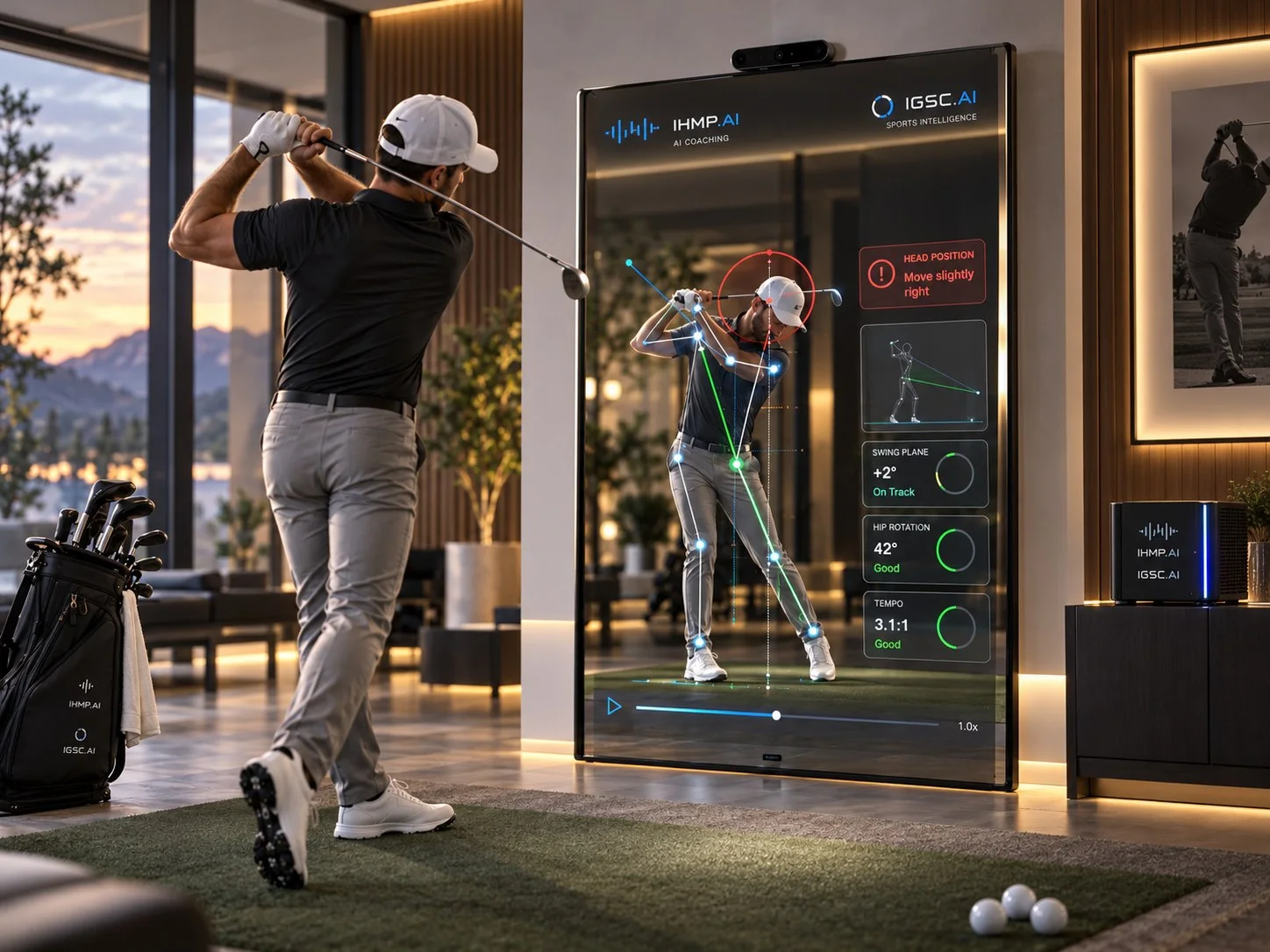
Intended capabilities for training on your own.
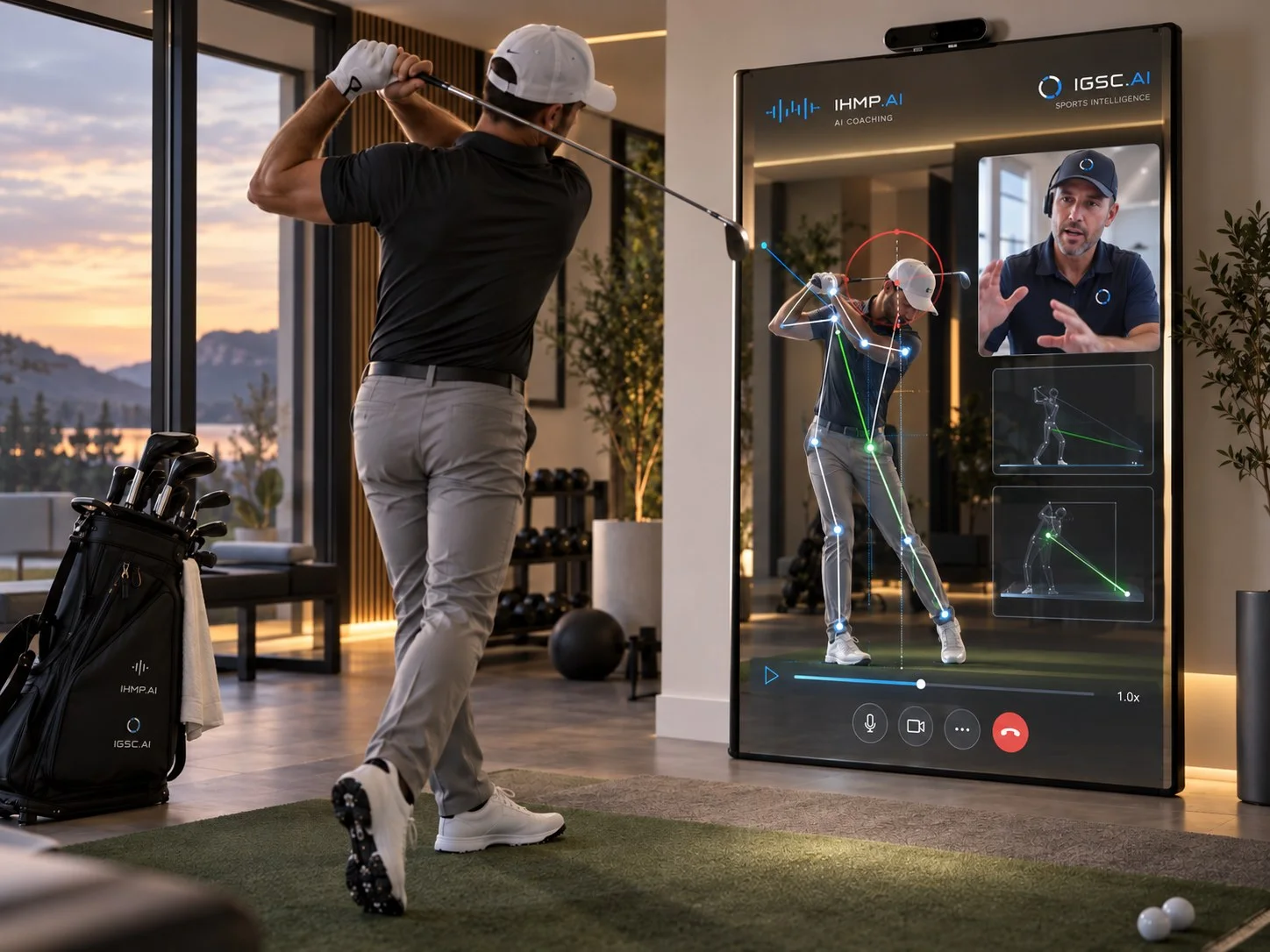
A future mode that needs design and verification.
Concept renderings only. Interface values, hardware form factor and product capabilities are illustrative and haven't been validated.
Platform extension
Movement capture, comparison, real-time processing and contextual feedback could inform future offerings well beyond golf. Each field would need its own validation, workflows, risk controls and business model. Every candidate below is a hypothesis to test.
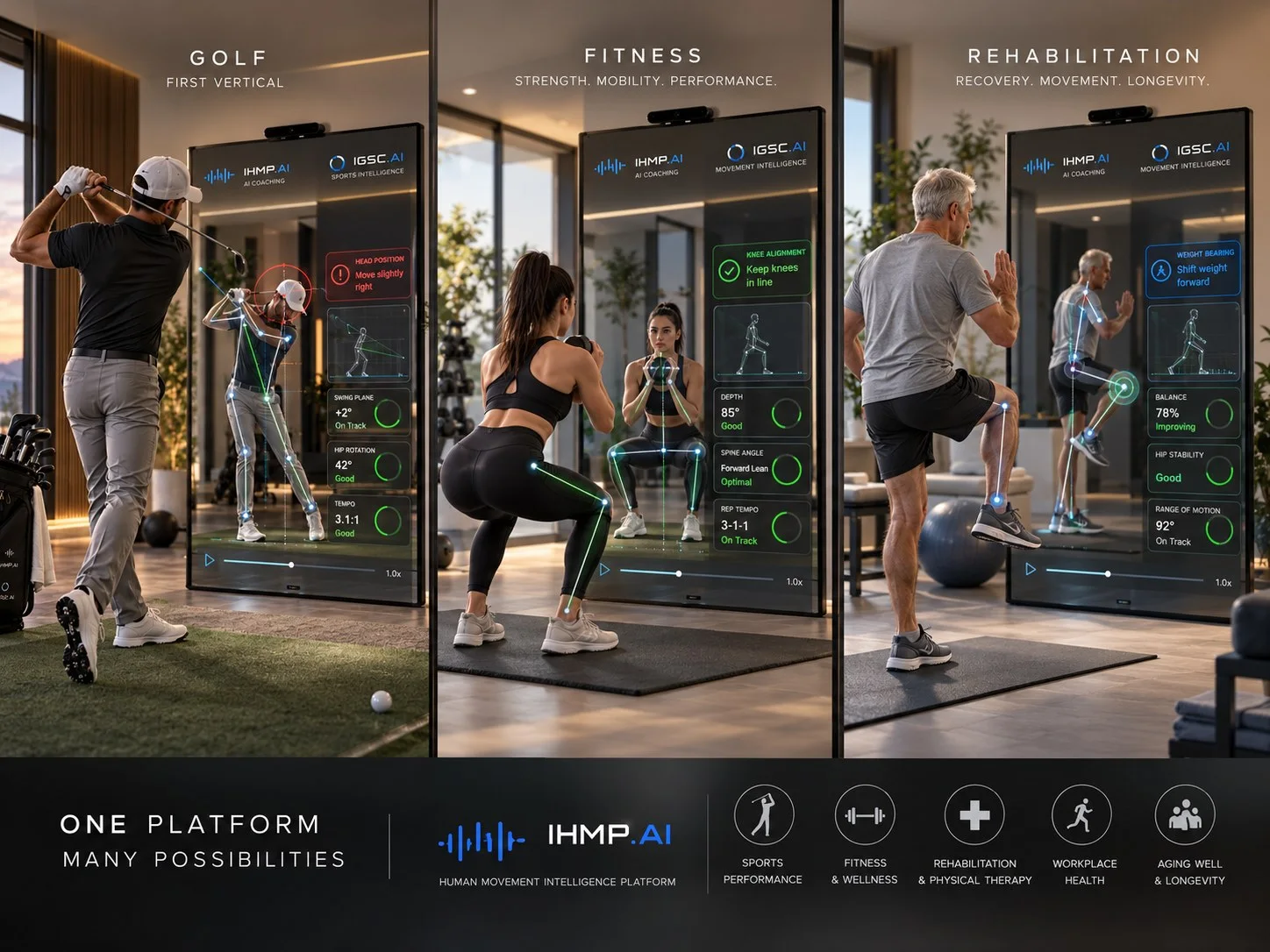
The initial target market and source of pricing evidence.
Entry verticalSpecialist movements and professional instruction.
HypothesisForm, repetitions and guided exercise.
HypothesisRequires clinical validation and extra safeguards.
HypothesisBalance and appropriate supervised activity.
HypothesisJob-task movement, training and safety workflows.
HypothesisA possible dual-use study. No DoD relationship implied.
HypothesisProposed · Georgia Tech Scheller College of Business
The technical assessment asks what can be built and at what cost. The proposed Scheller practicum asks who needs it, which golf customer to serve first, what they might pay, and what evidence would justify a pilot or further investment. Scheller participation still depends on program approval, staffing and an agreed scope.
Screen golf buyers and interview teaching professionals, practice facilities, academies, college programs and serious amateurs. Recommend the first reachable segment based on documented evidence, not assumptions.
Pick one more workstream based on readiness: pricing and unit economics (C), or partner selection, pilot metrics and milestones (D). Full market, pricing and pilot studies are too much for one small practicum.
Start with careful market-size estimates for golf, then screen plausible expansion markets. Deep cross-industry TAM/SAM/SOM work should be commissioned as follow-on work, not promised in one semester.
Code review, runtime architecture, camera-to-feedback latency, pose and correction accuracy, display integration, costs and required skills.
Interview evidence, golf beachhead selection, pricing or pilot design, competitive positioning and realistic commercial priorities.
Practicum scale: the October draft discussed 3–5 MBA students at about 20–30 hours each. For one term, a more credible scope is customer discovery plus at most one substantial additional module. Spring 2027 is a planning possibility, not a confirmed university engagement.
Proposed Module F · Market opportunity
We won't add up the entire sports, fitness, rehabilitation and industrial markets and call that IHMP.AI's market. A credible assessment separates reachable buyers, viable product setups, competing alternatives and the cost of entering each field.
Near term: evidence-backed golf customer segments, first golf TAM/SAM/SOM assumptions and a ranked shortlist of 2–3 expansion markets. Until the research is done, no dollar figure for market size or revenue is presented as fact.
Engineering development strategy
The technical review, proposed Scheller work and IP clarification should all lead to one demonstrator and one investment decision. University student-team participation depends on selection and approval.
Study the existing pipeline, work out what has to be replaced or re-engineered, and decide how to integrate the ZED 2i depth camera, GPU/edge compute, pose estimation, correction logic and mirror output.
Design for two complementary modes, individual training and future remote coaching, rather than limiting the product to a single swing-analysis app.
Target next phase: preparing for a possible Spring 2027 demonstrator effort, depending on assessment findings, the engineering team, resources and validation. University capstone participation isn't guaranteed.
Proposed non-dilutive support request
A roughly 90-day technical-readiness phase, with business-assessment scoping. This isn't presented as the cost of finishing a full commercial product.
Supporters would enable an independent technical report, verified baseline measurements, a costed engineering roadmap, and preparation for golf customer discovery and market-sizing work.
A full Scheller practicum and multi-market study would need separately confirmed academic arrangements and additional resources. The figures are planning numbers, not quotes received or money committed.
| Workstream | Amount | Share |
|---|
The proposed $4,000 business workstream covers project preparation, screening and research coordination. It is not a contracted full Georgia Tech MBA project or a complete seven-sector market study. All allocations are estimates, subject to professional quotes, program approvals and funding.
Inventory software, hardware and IP dependencies. Scope a Scheller proposal, screen initial golf customer segments and define market-sizing assumptions.
Benchmark the critical runtime pipeline. Draft the first golf customer-discovery questions and gather evidence requirements for pricing, a pilot and ranking expansion markets.
Deliver the technical findings, a costed demonstrator roadmap, a proposed Scheller project charter, a market-sizing research plan and prioritized business milestones.
These checkpoints cover the initial readiness phase, once funding and qualified leadership are in place.
Radical transparency
Serious backers deserve a plain list of what is proposed, what is a target and what is still unproven.
A planning request. No funding has been received.
Under review. Not approved, and not an institutional endorsement.
Engineering targets that haven't been verified yet.
AI-generated renderings of the planned experience, not a delivered product.
Opportunities to study, not proven markets or clinical claims.
Sponsored-research IP and licensing questions are under review with counsel.
For corporations, sponsors and network connectors
We welcome sponsor and investor conversations that support accountable technical-readiness work and evidence-based business research.
“The immediate goal is to establish the technical evidence, engineering team and business pathway required to turn a promising research foundation into a demonstrable product.”
Charles Brown · Founder, IHMP.AI / IGSC.AI
This form opens a draft in your own email app for you to review. It doesn't process payments or store any data on this website.
This sponsorship initiative is not a securities offering and carries no equity or financial-return commitment. Interested in an investor discussion? Request a private conversation →
Frequently asked questions
We've proposed a Spring 2027 MBA practicum, or another suitable engagement, to look at golf customer discovery, market entry and one more priority such as pricing or pilot design. Participation, staffing, fees, timing and deliverables aren't confirmed.
No. The proposed Module F would first estimate golf TAM/SAM/SOM using clearly defined buyers and assumptions, then screen seven candidate application groups, including sports, fitness, rehabilitation, aging, workplace movement and tactical training. A deeper multi-industry study would be scoped separately. No total market estimate or revenue forecast is presented as validated.
No. The $50,000 is a proposed initial technical-readiness budget, with $4,000 set aside for golf-market, Scheller practicum and pilot scoping. It doesn't guarantee an approved MBA practicum or a full multi-industry market report. Extra resources and university approvals may be needed.
No. The images here are concept art. IHMP.AI / IGSC.AI is working toward an integrated demonstrator. The ≥30 FPS and ≤100 ms end-to-end latency figures are engineering targets, not verified performance.
The budget prioritizes an independent technical architecture review, latency measurement and system-integration planning, with $4,000 to prepare golf-market research, a possible Scheller engagement and pilot scoping. It doesn't buy an entire commercial product or a guaranteed university practicum.
The platform is meant to serve both self-directed training and professional sessions. Future versions could support instructor-led programs, individual goals, consent-based professional access, session feedback and progress tracking. These capabilities still need design and verification.
Golf is the entry vertical. The same foundation could be adapted to fitness, rehabilitation, workplace safety or other movement settings, but those are opportunities to study, not validated products or clinical claims.
No. This page doesn't claim that any person, university, company or funding program has committed money, endorsed the campaign or agreed to provide services. Any collaboration would need its own engagement and approvals.
Questions about sponsored-research IP and licensing are under review with counsel. Any necessary rights and commercial arrangements must be settled before commercialization. Supporting the assessment doesn't grant rights to third-party IP.
Neither is assumed. IHMP.AI / IGSC.AI is a for-profit venture seeking negotiated, documented development sponsorship or other lawful support. Payments aren't presented as tax-deductible gifts, and equity discussions would happen separately.
The goal is an informed go/no-go or revised-build decision, an accountable engineering plan and early pilot criteria. A possible Spring 2027 demonstrator effort depends on team availability, technical feasibility, legal rights and resources.
The next 90 days
One accountable phase: an independent technical report, measured baselines and a costed roadmap to a go/no-go build decision.